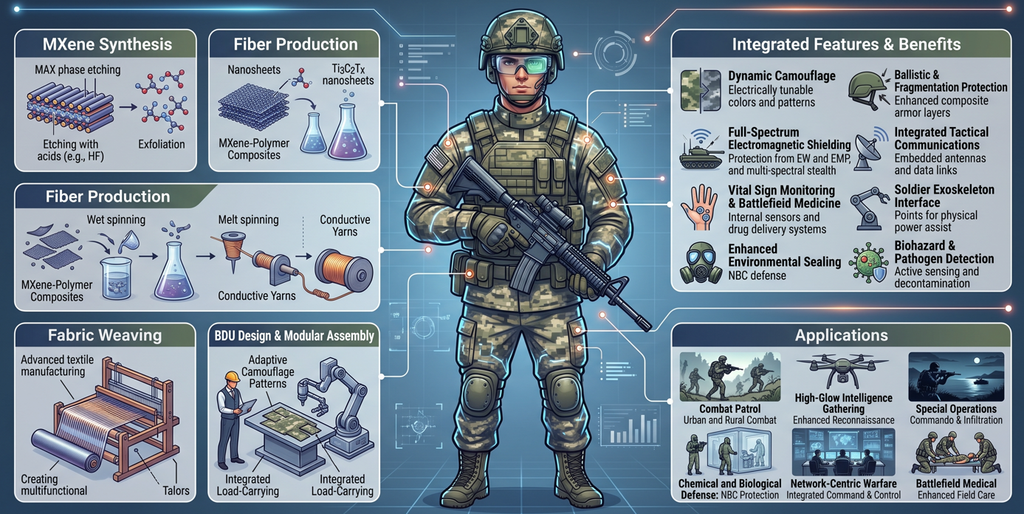
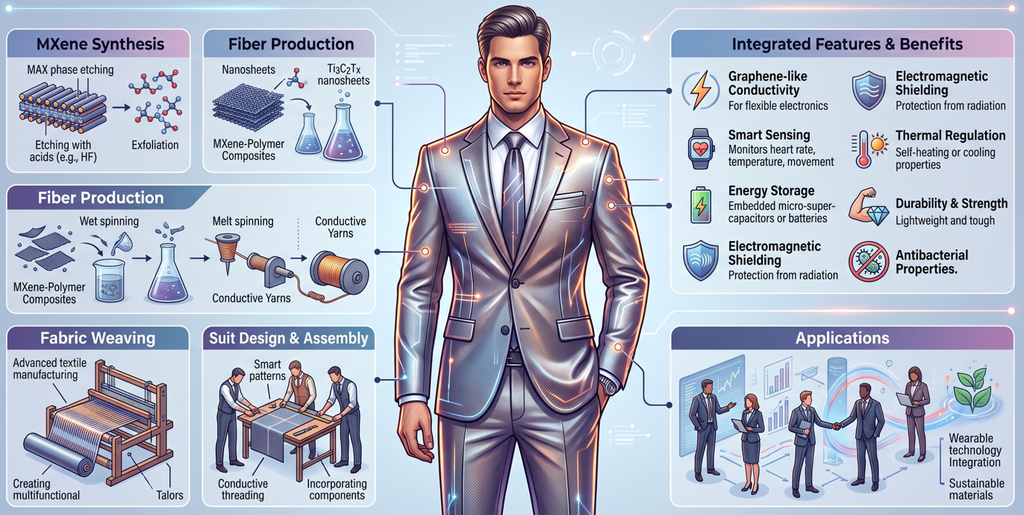
Synthesizing $\text{Ti}_3\text{C}_2\text{T}_x$ MXene involves selectively etching the aluminum (Al) layer from a bulk Ti₃AlC₂ MAX phase precursor using fluorine-containing etchants, followed by the delamination of the resulting multilayer stack into single- or few-layer 2D nanosheets. [1, 2, 3]
Precursor Preparation & Etching Methods
- Direct HF Etching: Uses concentrated hydrofluoric acid (e.g., 30–50 wt% HF) to dissolve the Al layer. While effective and fast, direct HF is extremely hazardous and tends to introduce more defects. [4, 5]
- MILD Method (In Situ HF / LiF + HCl): The Minimally Intensive Layer Delamination method uses a safer mixture of hydrochloric acid and lithium fluoride (LiF + HCl) to generate HF in situ. This simultaneously etches Al and intercalates Li⁺ ions, yielding high-purity, larger-flakes, and highly conductive $\text{Ti}_3\text{C}_2\text{T}_x$. [6, 7]
Delamination & Exfoliation
- Multilayer Washing: The acid-treated suspension is washed repeatedly with deionized water or diluted HCl via centrifugation until the supernatant reaches a neutral or near-neutral pH (~ 6) and stable, dark-green clay sediment forms. [2, 8]
- Delamination: Gentle hand-shaking, manual manual shearing, or mild sonication of the sediment in water forces the separation of swollen galleries, producing a stable colloidal dark-green supernatant of single- or few-layer $\text{Ti}_3\text{C}_2\text{T}_x$ flakes. [2, 9]
Processing & Storage
- Collection & Deposition: The colloidal single-layer MXene solution is separated by centrifugation and can be processed via vacuum filtration, spin coating, or blade coating. [9, 10]
- Oxidation Prevention: Terminated surfaces ($\text{T}_x = -\text{F}, -\text{OH}, -\text{O}$) are prone to oxidation into TiO₂ over time; storage requires airtight, oxygen-free vials under inert gas (argon/nitrogen) and refrigeration. [9]
If you’re planning a specific experiment, let me know if you need help with:
- Exact molar ratios and concentrations for the MILD method
- Characterization techniques (XRD, SEM, XPS)
- Optimization for electrical conductivity vs. yield
[3] https://open.library.ubc.ca
[4] https://www.sciencedirect.com
[5] https://pubmed.ncbi.nlm.nih.gov
[6] https://onlinelibrary.wiley.com
[7] https://advanced.onlinelibrary.wiley.com
[8] https://advanced.onlinelibrary.wiley.com
[10] https://pmc.ncbi.nlm.nih.gov
https://share.google/aimode/kks5mHxsmP427SrW4
Use your favorite video generator (flow.google) to create the following related videos:
Segment 1: Carbon Nanotube Fiber (CNTF) Direct Spinning (0:00 – 0:10) “A dynamic, industrial wide shot showing a glowing vertical tube furnace operating at 1200 °C, where carbon nanotube aerogels spontaneously entangle and are continuously drawn out into a water bath. The van der Waals-driven coagulation transforms the aerogel into dense, highly aligned CNT bundles that are continuously wound onto spools.”
Segment 2: Amine Functionalization (0:10 – 0:20) “A close-up tracking shot of the continuous CNT fibers being fed into a chemical bath heated to 90 °C. The fibers undergo a diazotization reaction with a mixture of 4-aminobenzylamine and sodium nitrite, chemically grafting polar amine groups onto the fiber surfaces to increase their hydrophilicity before being washed and dried in air.”
Segment 3: Ti3C2Tx MXene Synthesis (0:20 – 0:30) “A parallel mass production line showing the Minimally Intensive Layer Delamination (MILD) process. Precursor MAX phase powders are gradually introduced into a vigorously stirred etching solution at 35 °C, followed by high-speed centrifugation and vigorous shaking that yields a dark, single-layer aqueous Ti3C2Tx MXene dispersion.”
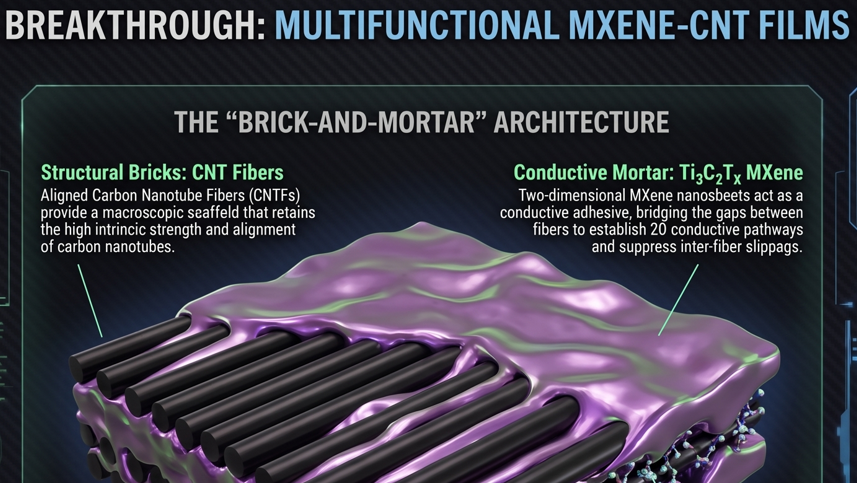
Segment 4: Continuous Assembly Process (0:30 – 0:40) “A macro-lens shot showing the amine-functionalized CNT fibers being continuously drawn seamlessly through a vat of the prepared aqueous Ti3C2Tx MXene dispersion. The liquid MXene conformally coats the aligned fibers, acting as a conductive mortar binding to the fibers via strong hydrogen bonding.”
Segment 5: Fiber Winding and Alignment (0:40 – 0:50) “A continuous winding mechanism is shown taking the wet, MXene-coated CNT fibers straight from the dispersion and precision-winding them onto a large, hollow rectangular Teflon frame. The fibers are laid down side-by-side in a perfectly parallel and highly aligned arrangement.”
Segment 6: Final Pressing into a Continuous Film (0:50 – 1:00) “The wound fibers are cut, unfolded into a large flat sheet, and fed into a heavy industrial cold press operating at 100 bar. The high pressure compresses the material to half its original thickness, yielding a dense, structurally robust, and continuous hybrid stealth film with a brick-and-mortar architecture.”