
Quantum computers won’t replace classical computing.
They’ll replace the impossible.
That distinction matters.
As companies like PsiQuantum pursue utility-scale, fault-tolerant quantum computers built around photonic qubits and semiconductor manufacturing, an entirely different challenge emerges:
How do humans interact with systems capable of exploring computational spaces that are far too large to understand directly?
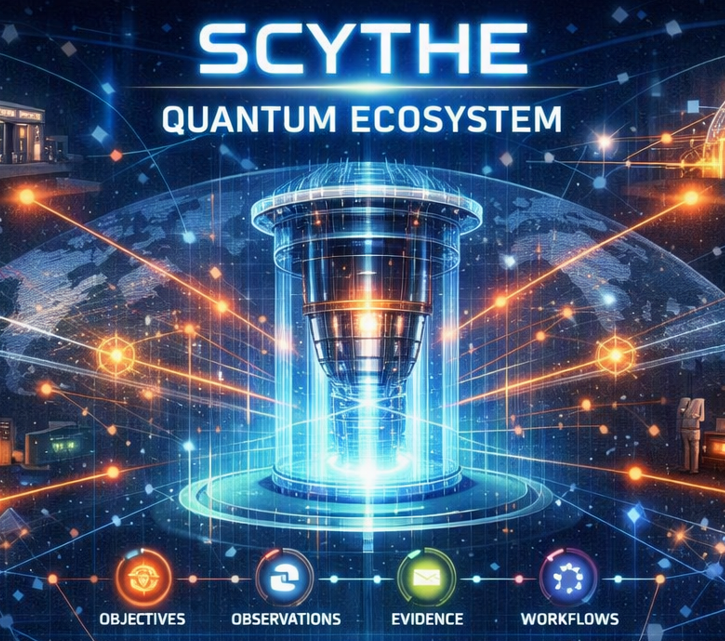
This is where SCYTHE enters the conversation.
Not as a quantum computer.
Not as a quantum programming language.
Instead, as an operational intelligence layer that helps people observe, manage, visualize, validate, and reason about extremely complex computational ecosystems.
Beyond Running Quantum Circuits
A future quantum computer will not simply execute circuits.
It will exist inside an ecosystem consisting of:
- Cryogenic infrastructure
- Optical networking
- Semiconductor manufacturing
- Massive experiment pipelines
- Classical preprocessing
- Classical post-processing
- Distributed storage
- Scheduling systems
- Scientific workflows
- Human operators
The quantum processor may be the star of the show.
Everything surrounding it determines whether discoveries become usable.
SCYTHE is designed around exactly this type of systems thinking.
The Mission Becomes the Unit of Computation
One of SCYTHE’s architectural ideas is that everything belongs to a Mission.
Instead of treating experiments as disconnected jobs, SCYTHE models:
- objectives
- evidence
- observations
- operators
- computational workflows
- derived knowledge
- provenance
- lifecycle
Imagine a quantum chemistry investigation.
Instead of simply submitting millions of circuits…
the entire investigation becomes a Mission.
Every simulation.
Every optimization.
Every measurement.
Every intermediate dataset.
Every visualization.
Every interpretation.
All become part of one deterministic operational record.
Hypergraphs Instead of Files
Modern scientific computing increasingly resembles a graph rather than a folder hierarchy.
Experiments reference:
- datasets
- algorithms
- calibration runs
- publications
- instruments
- collaborators
- software revisions
- optimization passes
SCYTHE’s hypergraph architecture treats these relationships as first-class objects rather than metadata.
For a quantum computing organization, this enables scientists to navigate relationships instead of searching directories.
Global Infrastructure Awareness
PsiQuantum’s public roadmap describes utility-scale quantum systems built around multiple facilities, advanced manufacturing, photonic networking, and modular infrastructure.
A future SCYTHE deployment could visualize that infrastructure as a living operational graph.
Imagine opening the Mission Hub and seeing:
- fabrication facilities
- cryogenic cabinets
- optical links
- compute clusters
- storage systems
- experiment queues
- scientific workflows
all synchronized inside a single operational picture.
From Dashboards to Operational Intelligence
Traditional dashboards answer:
“What is happening?”
SCYTHE attempts to answer:
“What does this mean?”
Its Reality Prism concept can assemble evidence from multiple perspectives into a unified operational context.
For a quantum engineering organization this could include:
- hardware telemetry
- experiment history
- calibration drift
- software revisions
- manufacturing batches
- resource utilization
- scheduling decisions
Instead of dozens of isolated dashboards, operators interact with a coherent knowledge graph.
AI as an Interpreter—Not an Authority
One of SCYTHE’s design principles is simple:
AI produces interpretations.
Evidence produces observations.
That distinction becomes even more important in quantum computing.
Large language models can help explain:
- optimization opportunities
- scheduling conflicts
- experiment summaries
- anomaly candidates
- documentation
But they should never replace the underlying evidence.
Every conclusion should remain traceable to the originating data.
Mission Replay
Scientific reproducibility is one of the biggest challenges in computational research.
Imagine replaying an entire quantum investigation.
Not merely rerunning code.
Replaying:
- experiment state
- operator decisions
- software versions
- optimization choices
- evidence collected
- graph evolution
SCYTHE’s Mission architecture is naturally aligned with this concept.
Multi-Scale Visualization
A utility-scale quantum computer spans many layers simultaneously.
At one end:
individual photonic devices
At the other:
national infrastructure.
SCYTHE’s synchronized viewports could allow engineers to move fluidly between:
- facility overview
- hardware topology
- dependency graph
- experiment timeline
- resource allocation
- operational health
without losing mission context.
GraphOps for Scientific Operations
Future scientific organizations may manage millions—or billions—of relationships.
GraphOps provides a way to perform deterministic transformations on those relationships.
Potential examples include:
- identifying calibration dependencies
- discovering duplicate experiment branches
- tracing provenance across publications
- detecting conflicting assumptions
- measuring impact before workflow changes
Rather than editing data directly, GraphOps proposes controlled graph transformations with explicit review and provenance.
The Human Remains in Control
As computational systems become more autonomous, operator trust becomes increasingly important.
SCYTHE emphasizes:
- deterministic state
- lifecycle governance
- revision-pinned operations
- reproducible evidence
- auditable changes
These principles become more valuable—not less—as computational complexity grows.
Looking Ahead
PsiQuantum is pursuing one of the most ambitious engineering efforts of our time: building utility-scale, fault-tolerant quantum computers using silicon photonics and modular infrastructure.
If that vision succeeds, the challenge will extend beyond quantum hardware.
Scientists, engineers, operators, and AI systems will need to work together across enormous computational and operational graphs.
A platform like SCYTHE could serve as the connective tissue between those worlds—not replacing quantum computers, but helping people understand, manage, and trust the ecosystems that surround them.
The future of computing may not belong to classical or quantum systems alone.
It may belong to the operational platforms that allow both to work together as one coherent mission.