
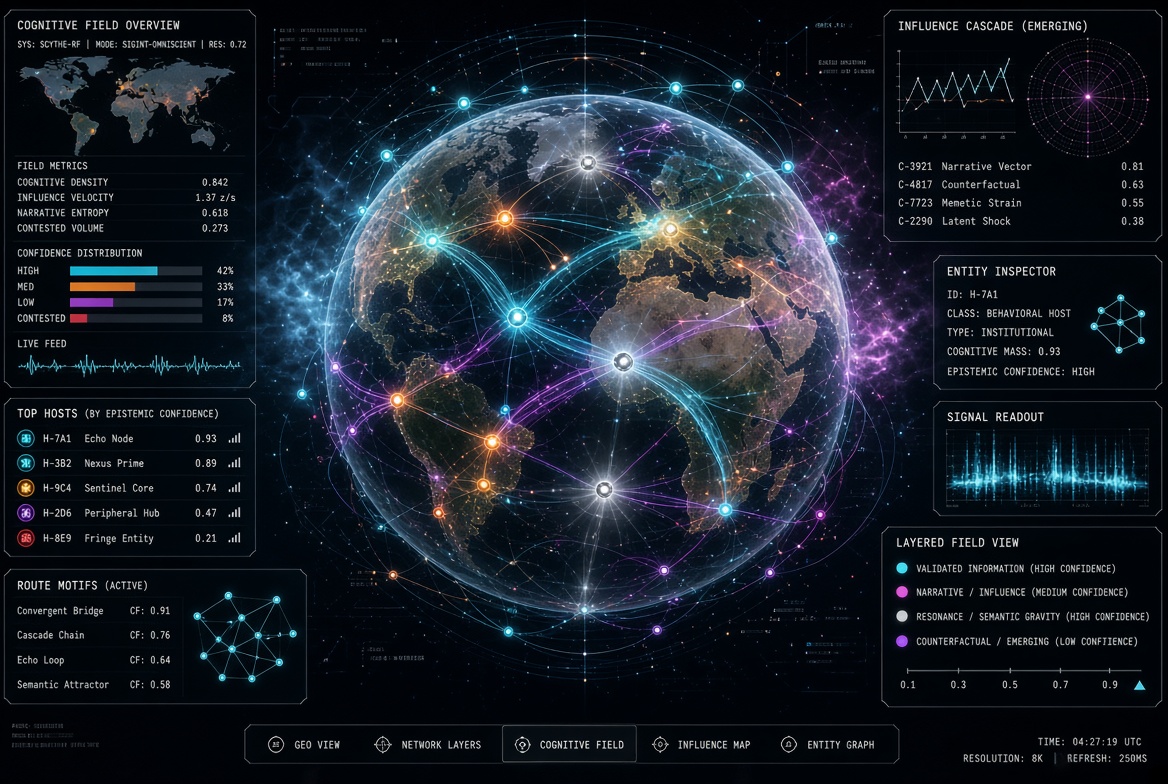
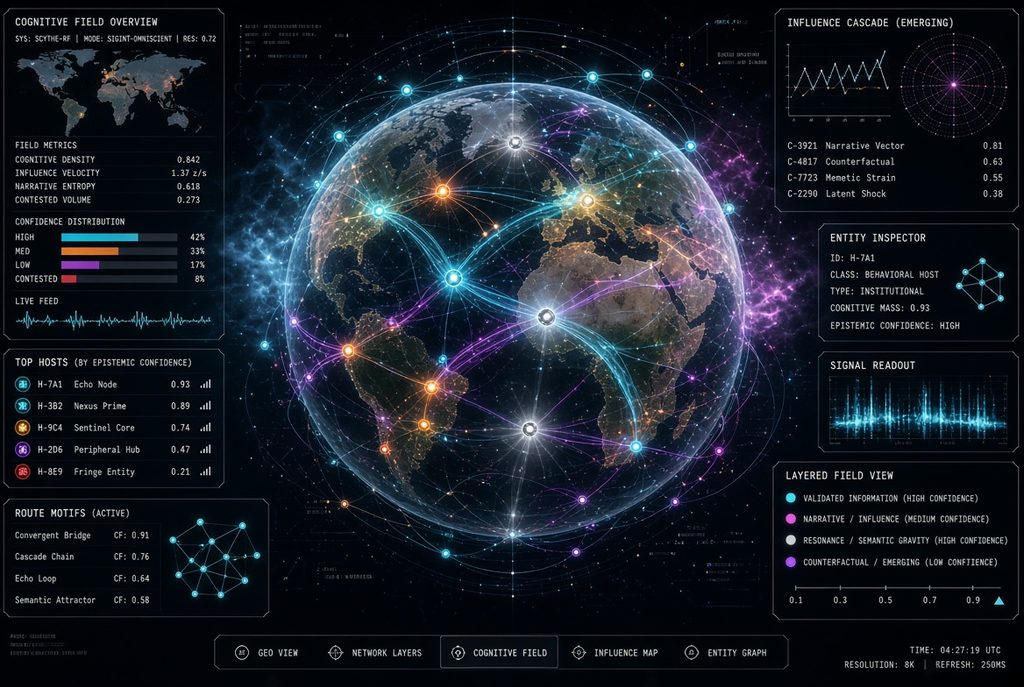
SCYTHE (the bgilbert1984 project) is a dense command-operations visualization and reasoning layer. It fuses RF/SIGINT, PCAP-derived network entities, hypergraph relationship modeling, geospatial overlays (Cesium + MapLibre + deck.gl), route ecology/inference engines, live streams, and operator-facing “command picture” tooling into one explorable workspace. It is built for high-density situational awareness where tables fail and relationships, uncertainty, movement, and multi-modal evidence must share the same view.
Given full creative freedom, I would push it far beyond pure RF/recon dashboards into living, multi-scale “cognitive field” systems that treat the world as an evolving hypergraph of signals, behaviors, and counterfactuals. Here are the directions I would take it:
1. Planetary-scale ecological & infrastructure nervous system
Treat the entire surface of Earth (plus near-space and undersea) as the operating environment. Ingest:
- RF emissions, AIS, ADS-B, satellite telemetry, IoT sensor nets, power-grid phasors, seismic/acoustic arrays, and open PCAP from research or cooperative networks.
- Live ecological proxies (animal migration tags, ocean buoy data, forest acoustic sensors, agricultural IoT).
The hypergraph + Cesium globe becomes a real-time “biosphere + anthroposphere” atlas. Route-ecology and niche-succession engines already present in the codebase would model cascading effects: a solar-flare-driven RF outage → shipping route disruption → port congestion → supply-chain phenotype shift. Operators (or autonomous agents) could run counterfactual shockwaves (“what if this undersea cable is cut?”) and watch the fitness landscape and resonance ledger update live. Goal: early-warning system for compound infrastructure–ecological failures that current siloed tools miss.
2. Cognitive & behavioral field laboratory
The CognitionECS, BehavioralFieldPhysics, HostCognitionGraph, EpistemicConfidenceGraph, and CounterfactualUniverseEngine pieces already lean this way. I would turn SCYTHE into an experimental platform for modeling collective cognition and influence at scale:
- Map information flow, narrative propagation, and “behavioral hosts” across social, RF, and network layers.
- Run multi-branch counterfactual replays of influence campaigns or crisis information environments.
- Visualize epistemic confidence decay, semantic gravity wells, and resonance ledgers in 3D geospatial + abstract hypergraph space.
This could serve research groups studying misinformation dynamics, crisis communication, or even large-scale human–AI hybrid decision making—always with strong provenance and immutable event logging.
3. Scientific instrument fusion layer (RF + multi-messenger)
Leverage the existing RF tomography, Gaussian-splatting style RF scene representation work, and the broader SCYTHE visualization stack to create a unified “observatory” for multi-messenger science:
- Overlay radio astronomy (or terrestrial RF surveys), neutrino/ gravitational-wave alerts, optical transient data, and particle-physics event streams (the README already flirts with JWST/LHC-style ideas).
- Use the hypergraph and route/genome engines to discover unexpected correlations across modalities in real time.
- Provide a collaborative multi-operator room so distributed science teams share a single high-fidelity command picture instead of screenshots and email.
4. Adaptive simulation & training “living range”
Combine the WriteBus, multi-instance orchestrator, ReplayEngine, and SimulationClock into a high-fidelity, physics-aware digital twin range. Operators could:
- Inject synthetic RF, network, and geospatial events.
- Train detection and response under realistic uncertainty and partial observability.
- Run continuous red/blue/purple exercises where the environment itself evolves (niche succession, route phenotype changes, host identity drift).
Because everything is already graph- and field-oriented, the same platform could support both pure simulation and live data injection without a hard boundary.
5. Personal / small-team “augmented awareness” instances
Scale the multi-instance orchestrator down so individuals or small research groups can spin private SCYTHE bubbles. Feed personal or lab-scale data (SDR captures, local network traffic, sensor feeds, research notes) and get a private hypergraph + globe workspace that grows with their own ontology. The modular JS/Python surface already lends itself to this.
Design principles I would enforce
- Uncertainty and provenance first: every entity, edge, and inference carries confidence, lineage, and an immutable log.
- Multi-scale coherence: the same underlying graph can be viewed as RF voxels, network flows, geospatial arcs, or abstract cognitive fields without losing consistency.
- Operator + agent hybrid: human operators stay in the loop while autonomous “field agents” propose hypotheses, run counterfactuals, and surface anomalies.
- Open experimental surface: keep the browser-native, modular, WriteBus-centered architecture so researchers can plug new physics, new sensors, or new inference engines without rewriting the core.
In short, I would treat SCYTHE less as a finished RF/command dashboard and more as a general-purpose “reality hypergraph engine”—a place where signal, structure, movement, and possibility can be made visible, queryable, and steerable at the same time. The existing Cesium/hypergraph/RF/PCAP foundation is already unusually well-suited for that kind of ambitious fusion.